| UTM-X | UTM-Y | ||
|---|---|---|---|
| STOP 1: THE FOSSIL DUNES | |||
| STOP 2: LIMESTONES WITH CRINOIDS | |||
| STOP 3: PHOSPHATE NODULES | |||
| STOP 4: ESCULL DES FRANCÈS | |||
| STOP 5: RED LLOSELLA | |||
| STOP 6: RADIOLARITES | |||
| STOP 7: THE CALESMORTS THRUST |
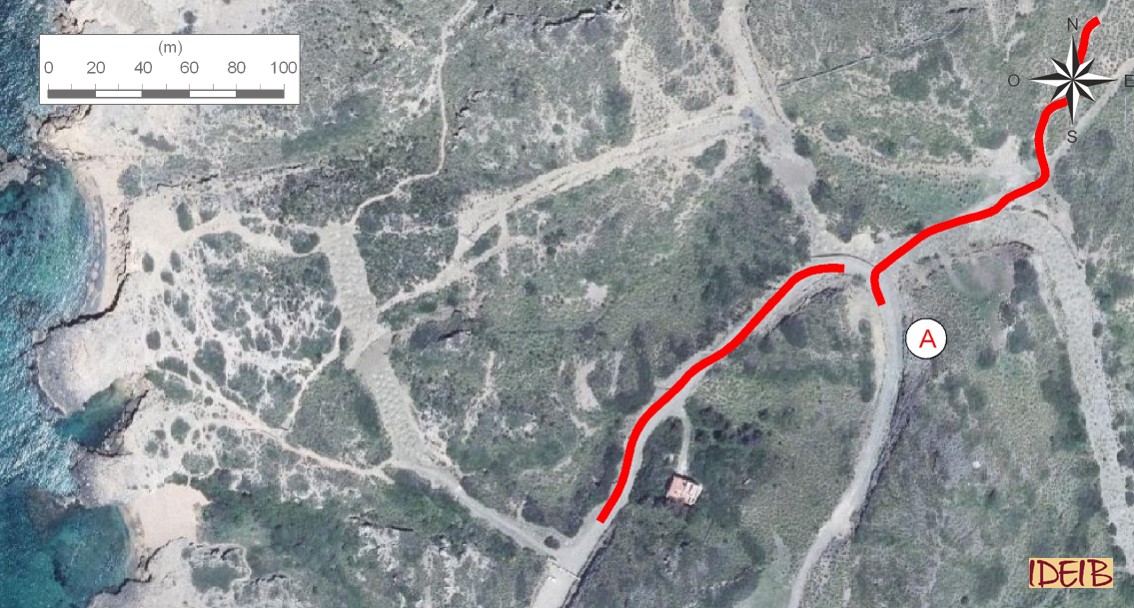
Access route to the stopping point and continuation towards the next one.
Outcrops of radiolarites are abundant at the Binimel·là massif. This point represents the highest tectonic, eustatic or antropical processes</span></p></div>">outcrop and is characterised by its good state of conservation. It features spectacular forms and is easily accessible as a result of the small road built to reach the highest villa in the residential area. Radiolarites are a rather unique type of rock as a consequence of the conditions needed for their sedimentation. They are folded silicate rocks formed by the accumulation of skeletons of organisms called radiolaria, interleaved between fine layers of sedimentary rock which tends to exfoliate in small flakes, similar to sedimentary rock formed by clay.</p></div>">pelite. </p></div>">llosella. The outcrops are outstanding due to a very clear stratification and to very well modelled folds as a consequence of the plasticity of the rock. Occasionally, you can see small faults. It is known popularly as firestone due to the fact that its silicate composition makes the rock very hard and means that sparks can be made to fly when you scrape a piece of iron across it.
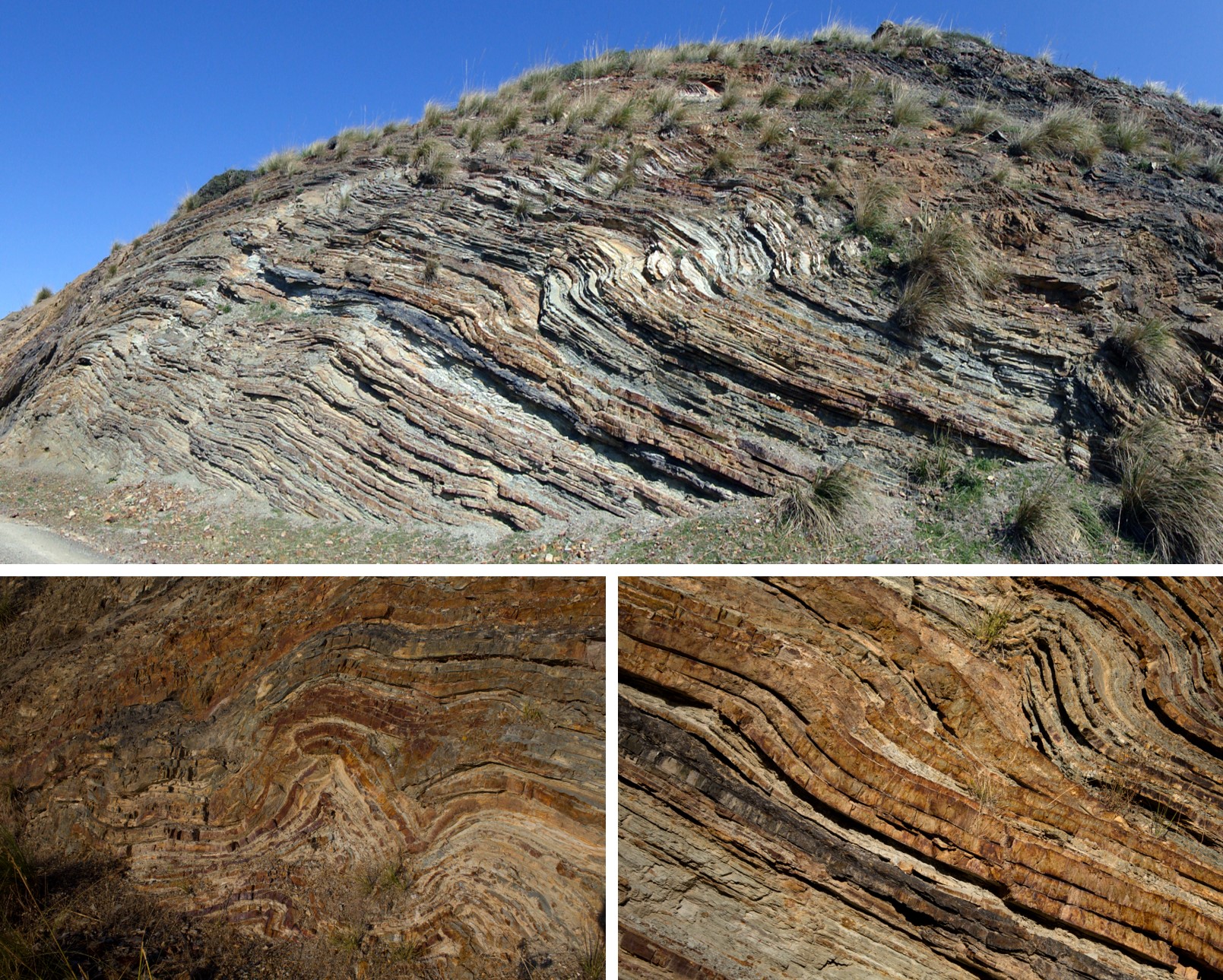
General view of the outcrop and close-up of the folds and undulations (point A).
The alternation of layers of radiolarites with fine layers of sedimentary rock which tends to exfoliate in small flakes, similar to sedimentary rock formed by clay.</p></div>">pelite. </p></div>">llosella clearly allow the stratification to be seen. The layers display thicknesses of up to 10 cm, with a predominance of those measuring 5 cm with various green, black and red colourations. Very hard and difficult to erode, the layers stand out in the relief. Due to their hardness, the folds are associated with the fact that during the phase when these materials deformed, the sediments had not yet consolidated.
Radiolaria have a silicate (opal), spherical and perforated skeleton, and although their skeletons are colourless, the rocks that they form display usually brown colourations, although also black (called lydites), green and even dark red. These varieties in colour are in response to the presence of organic and inorganic substances at the time the rock was formed, such as the existence of iron minerals like haematite.
They are planktonic organisms that float in the sea, and when they die, their skeletons are deposited very slowly on the bed. Their existence is known of since the Cambrian (over 500 million years ago) and they are currently not as common as they were in past periods. They live far from the talus and are common in warm seas with volcanic activity, which entails the presence of abundant silica in the sea needed for these organisms to survive.
This way, we can relate these rocks to the red and white clays and silts identified at the previous stopping point, which can even contain some radiolaria in their composition. The two rocks are formed from sediments that we find in the open sea and can have some relationship with volcanic activity. Similarly, the minuscule size of the components that form these rocks means that they are characterised by an extremely slow speed of sedimentation; we can reckon that a thousand years are needed to form a level of just 0.5 cm of radiolarites.
When the sea cools down, they die en masse and a new detrital sedimentary cycle starts, which will end up giving rise to layers of sedimentary rock which tends to exfoliate in small flakes, similar to sedimentary rock formed by clay.</p></div>">pelite. </p></div>">llosella. In other words, the deposition of some particles begins, such as clays, resulting primarily from the disintegration and crushing of an existing rock. This way, we can see that the talus is made up of hard layers of radiolarites that alternate with soft layers of lloselles formed by the accumulation of clays and silts at times of drops in the sea temperature. This alternation allows us to see the stratification of the rocks clearly, as when the layers of radiolarites coincide due to the absence of lloselles, they become a homogeneous silicate mass of impracticable differentiation.
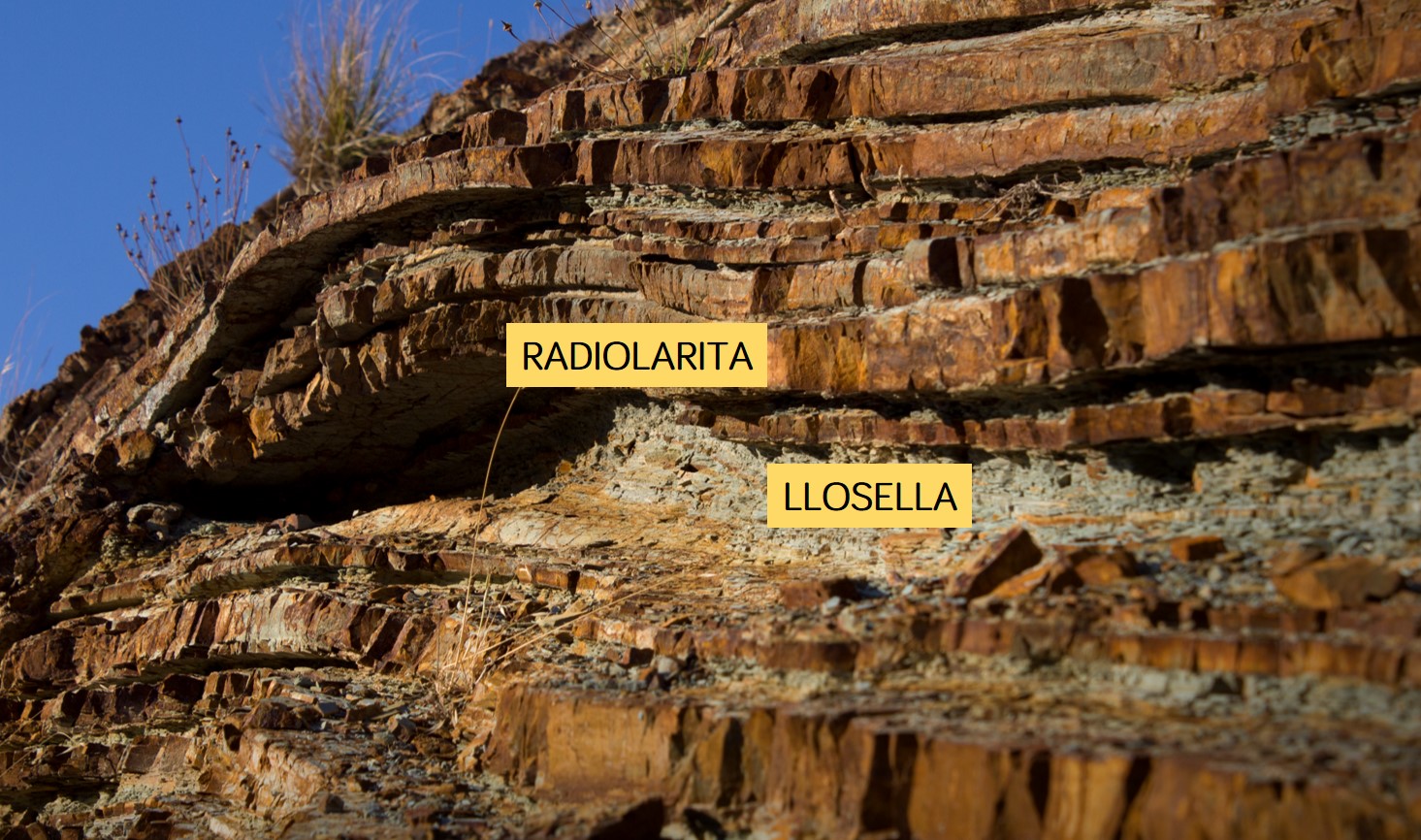
Layers of llosella interleaved between the layers of radiolarites (point A).
