| UTM-X | UTM-Y | ||
|---|---|---|---|
| STOP 1: CALA PI | |||
| STOP2: ROMAN QUARRY | |||
| STOP 3: MOUTH OF THE TORRENT GROS | |||
| STOP 4: CLIFFS OF S’ALAVERN |
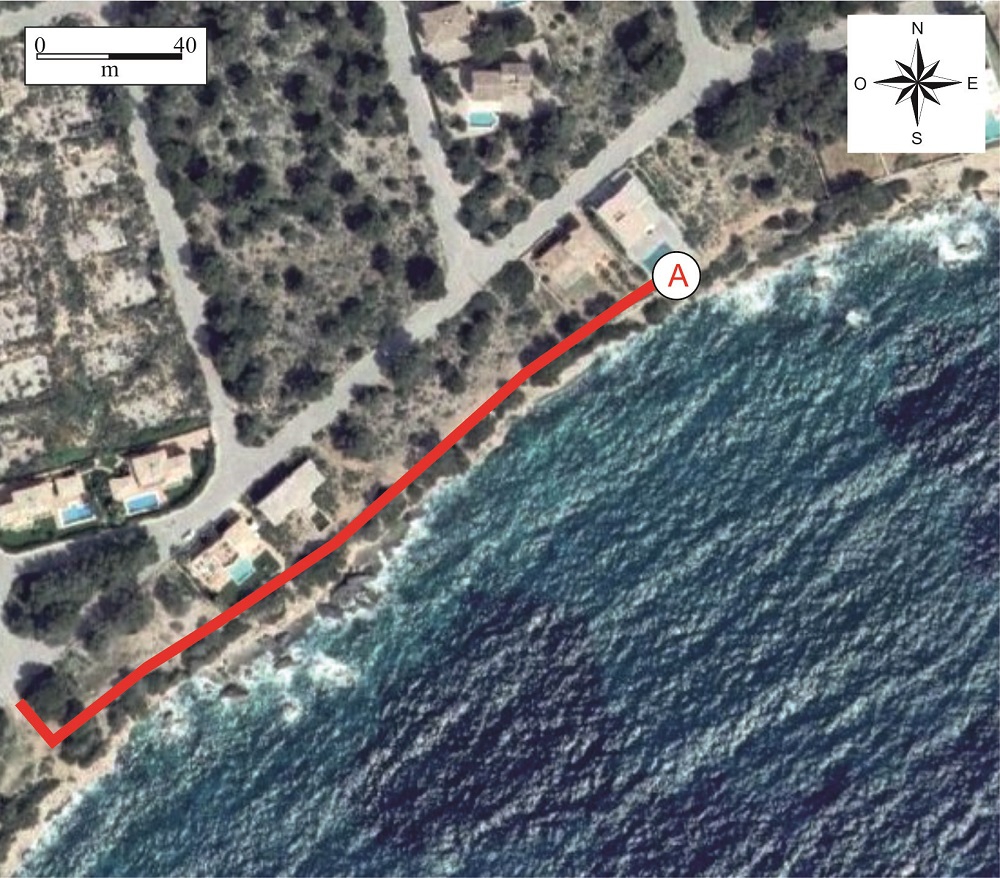
Recommended access.
Walking from where we have reached the mouth of the Torrent Gros along the cliffs towards the northwest we have a bird’s-eye view of the cliffs of S’Alavern, where we see another stratigraphic series deposited during a determined interval of geological time.</p></div>">stratigraphic column of the materials that compose this part of the island and the summary of its geological record from 7 Ma ago to the present day.

Stratigraphic elevation of the cliffs.
As at the mouth of the Torrent Gros, the trench we observe at sea level corresponds to the Reef Unit of the Tortonian-Messinian (from approximately 7 Ma to 5.7 Ma), with levels of stromatolites (lagoon stratigraphic unit and reflect the specific environmental conditions in which they were formed.</p><p><br></p></div>">facies) and karstified levels with indices of hydrothermal processes.
Above these, the sediments of the Terminal Complex were deposited, also of the Messinian (from 5.7 Ma to 5.2 Ma), characterised by the presence of whitish-grey marls with vertical traces of roots and with frequent levels of ostreids (mangrove swamp stratigraphic unit and reflect the specific environmental conditions in which they were formed.</p><p><br></p></div>">facies).
At the end of this period (5.2 Ma) there occurred the second surge in the desiccation of the Mediterranean and then the entry of water and subsequent re-flooding during the Pliocene. There was an explosion of life (lag) and beach sediments were deposited, which indicates a marine regression since they vary between the subtidal zone and the dunes.
Finally, and over all of these levels, a series of Pleistocene dunes and paleosols were deposited, where it is possible to observe morphologies related with pupation chambers of ants.
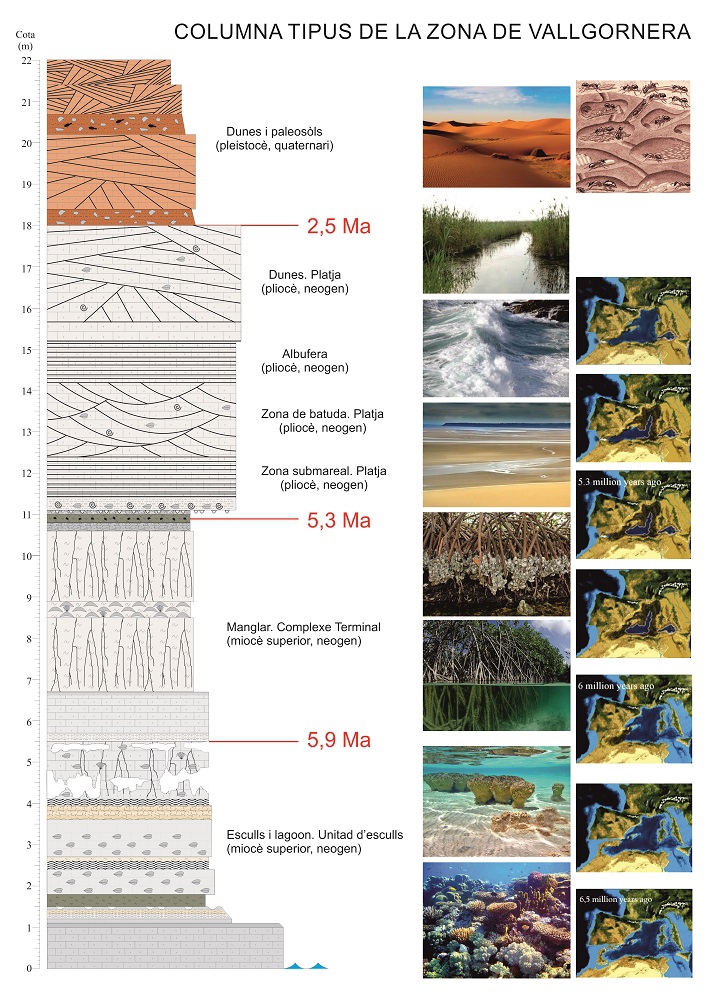
Stratigraphic column of the materials of the cliffs of S’Alavern and their genetic interpretation.
