| UTM-X | UTM-Y | ||
|---|---|---|---|
| STOP 1: CALA PI | |||
| STOP2: ROMAN QUARRY | |||
| STOP 3: MOUTH OF THE TORRENT GROS | |||
| STOP 4: CLIFFS OF S’ALAVERN |
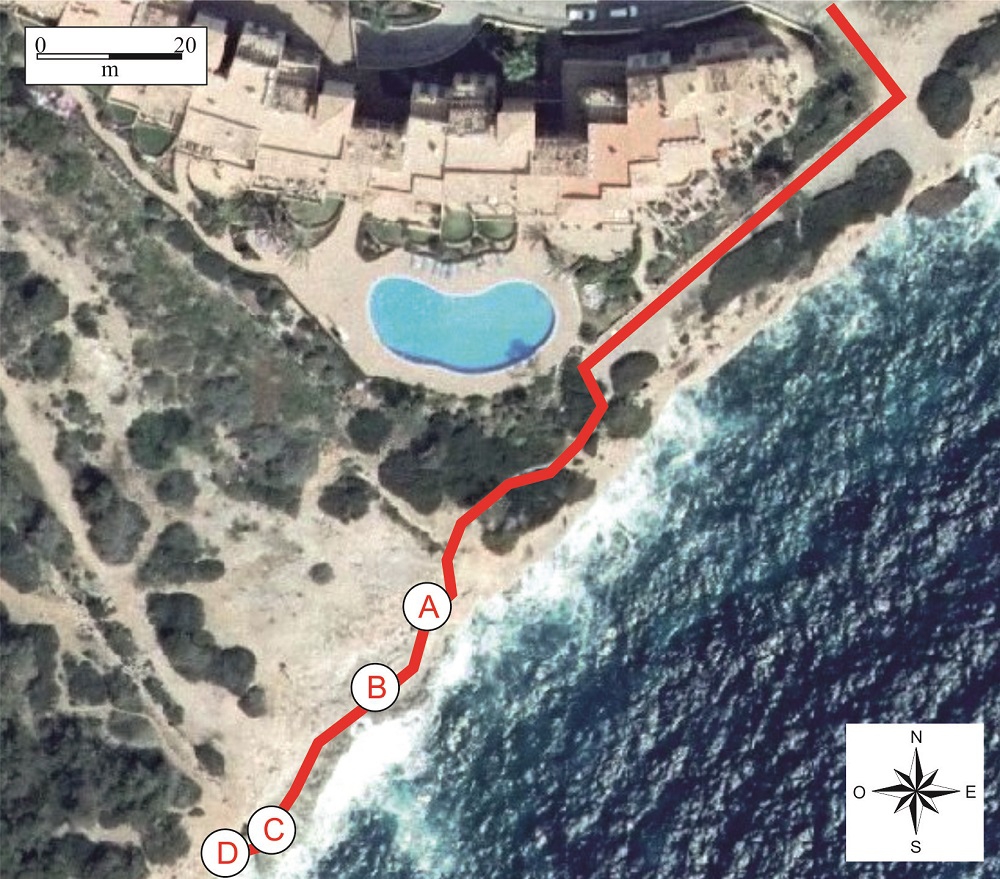
Recommended route.
The coast of Cala Pi and Vallgornera consists of a series of substantial outcrops in which the geology of the Miocene, Pliocene and Pleistocene can be studied in detail. One of the best exposed and most accessible outcrops of the sector lies in the vicinity of the mouth of the Torrent Gros.
As in the rest of the sites of the sector, its oldest levels (at the base of the cliff) correspond to the Upper Miocene (12-5,3 Ma, approximately), at a moment when large coral reefs lived on the Balearic Islands. The fossils of corals and molluscs at this point testify to this tropical environment.
In this same zone, where a small marine trench has been formed, we can observe a series of branching morphologies. They are not fossils but cracks filled by the circulation of high-temperature fluids from the depths of the earth’s crust. This type of phenomena, generically named hydrothermalism, is well documented in the cave of Es Pas de Vallgornera, the entrance of which is located some 450 metres from this tectonic, eustatic or antropical processes</span></p></div>">outcrop.

Detail of the materials of the cliff.
Above these lower levels there are others, also from the Upper Miocene, named Terminal Complex. In them, instead of the above-mentioned reefs, there appear mangrove swamps, coastal zones covered by trees that are highly resistant to the salinity of seawater. Nowadays they are found in zones close to the Equator, but in the Miocene they live on the Mediterranean coasts, which had a tropical climate. What we now see as remains of this ecosystem are the moulds of the characteristic vertical roots of the mangrove trees.
These mangrove swamps predated a catastrophic event which occurred at the end of the Miocene, almost 6 Ma ago: the desiccation of the Mediterranean, also known as the Messinian Salinity Crisis. To this day there is considerable discussion over its causes, but in any case they are related with the breakage of communication with the Atlantic, which converted the Mediterranean into a huge lake. During this period, both the mangrove swamps and the large tropical reefs disappeared. In addition, the exposure to the air of previously submerged zones generated large-scale erosive and karstic processes. In this tectonic, eustatic or antropical processes</span></p></div>">outcrop, these facts are manifested by the deterioration displayed by the upper limit of the Miocene, which is eroded and degraded by the dissolution of the rock.
The Salinity Crisis ended with a massive re-entry of the Atlantic (transgression), starting the Pliocene period (5.3-2.5 Ma) and forming beaches that occupy large extensions in some parts of Mallorca. In the specific case of this site, the Pliocene deposits begin at a level with abundant perforations of lithophagous molluscs commonly called ‘sea dates’ which are indicative of rocky coasts, which due to their structure receive the name of Lag. This tells us of the presence of an ancient coastline that was colonised by these organisms.
Above this level lie what are, strictly speaking, the beach deposits, which display a vertical variation in the sedimentary environment in which they were formed: while the lower levels were formed in the zone comprised between the wave base level and the low tide line (subtidal zone), the levels of large accumulation of mollusc fossils (lumaquelas) were formed in the wave beating zone (foreshore), and the higher levels correspond to backshore deposits (above the high tide line).

Various views of the Pliocene lumaquela
All of this denotes a progressive lowering of the sea level (regression).
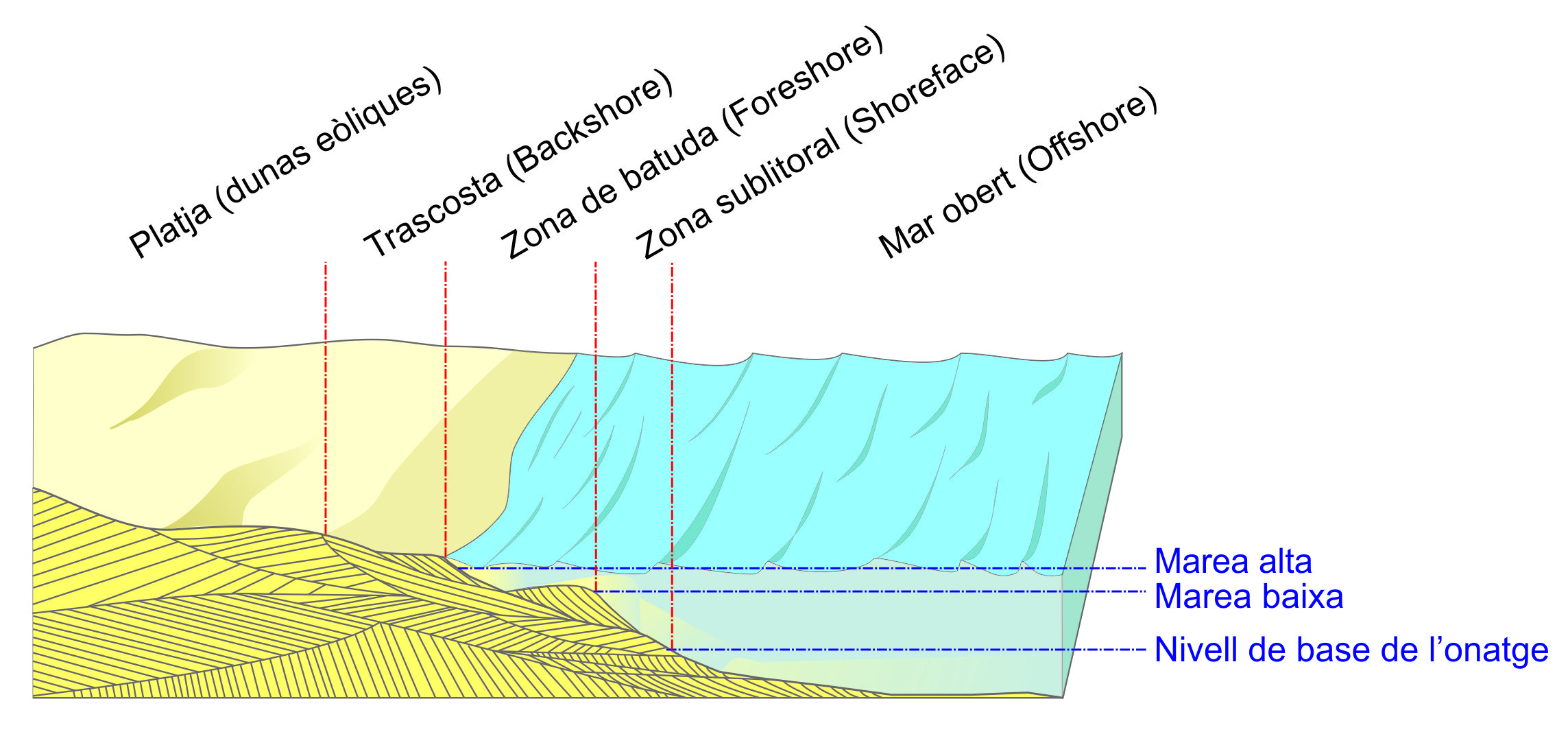
Zones of the beach (modified from Arche, 1992).
The Pliocene beach deposits give way to fully continental levels, which largely correspond to the Pleistocene (2.5 Ma-10,000 years), with no apparent marine influence. As in many other outcrops in the island, the continental deposits are formed basically of ancient soils (called paleosols) and dunes. In the dunes it is possible to see their characteristic cross-stratification created by the different directions of the winds that carried the sand that formed them.
Finally, we can comment that on the surface of the mouth of the torrent there are some rare radial morphologies, which are the result of blasts with explosives.
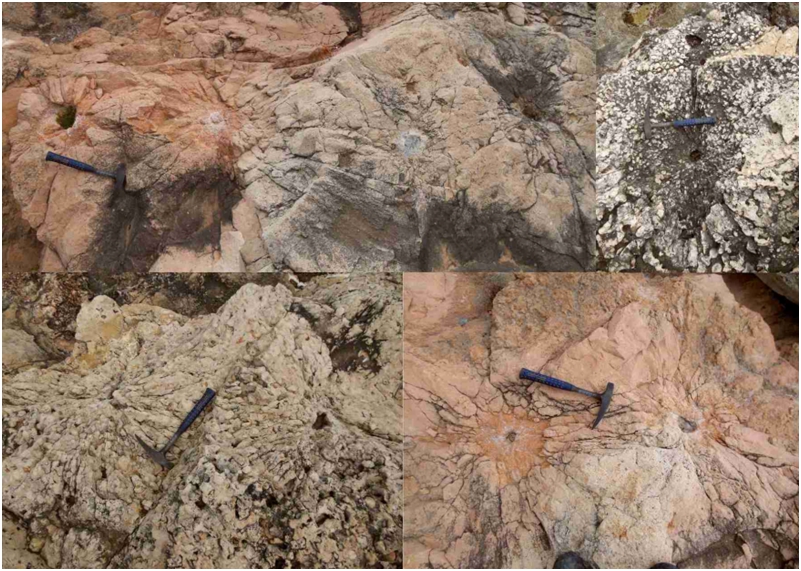
Radial-shaped surface morphologies.
